
hongma@hongmamotor.com
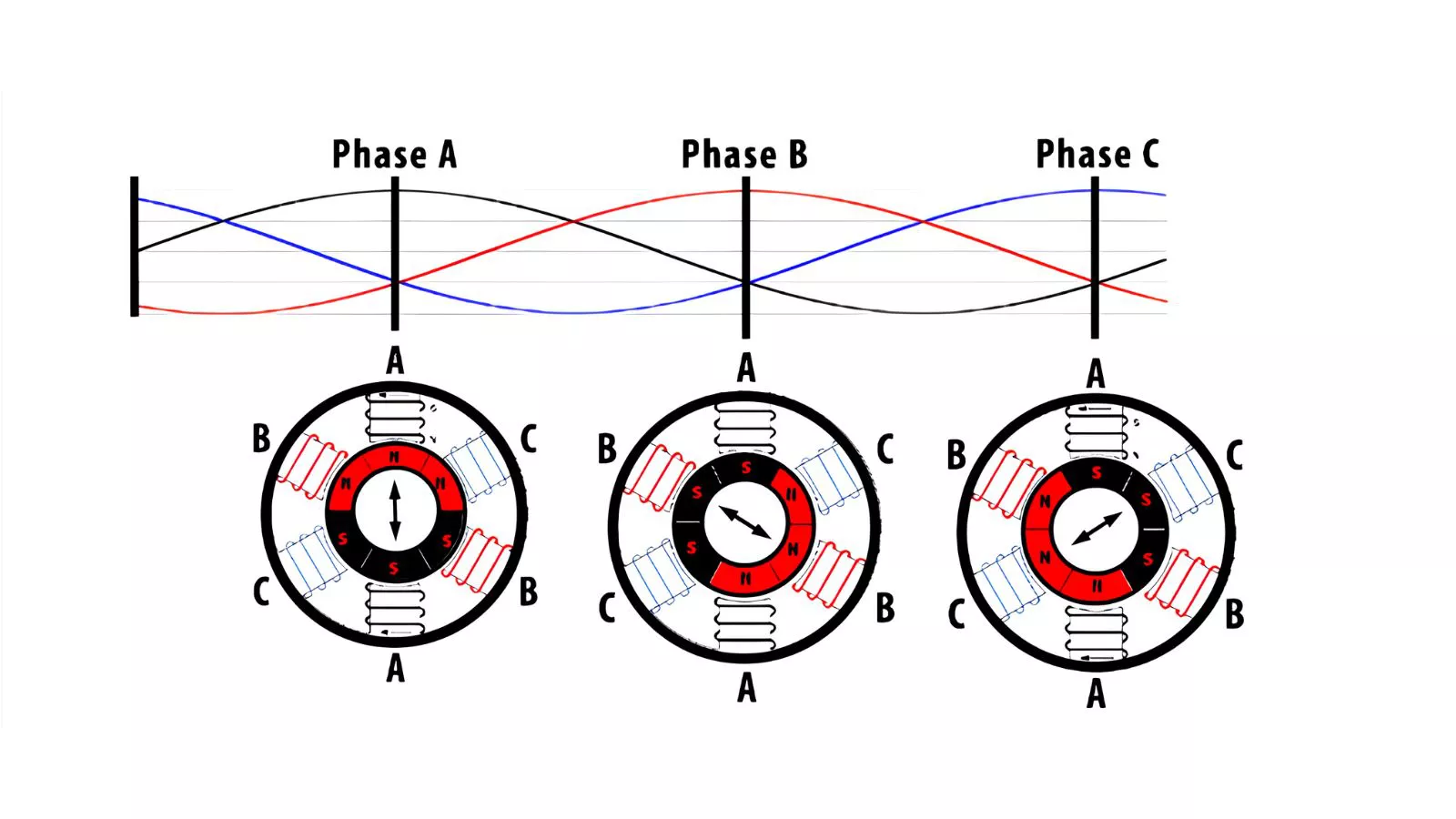
A three phase induction motor is an AC electric motor that converts three-phase electrical energy into mechanical energy through electromagnetic induction. It is widely used in industrial equipment because of its simple construction, reliable operation, and low maintenance requirements.
Unlike a motor that relies on a direct electrical connection to its rotor, an induction motor generates current in the rotor through a changing magnetic field. This allows the rotor to turn without needing a direct power supply connection in most designs.
Imagine a factory water pump running continuously throughout a long working shift. The motor starts, drives the pump shaft, and keeps water flowing through the pipes. There is no need for constant manual adjustment. This is a typical example of how a three phase induction motor supports everyday industrial operations.
Most three phase induction motors consist of two main components:
How does this process work in practice?
When three-phase AC power enters the stator windings, it creates a rotating magnetic field inside the motor. This field cuts across the rotor conductors and induces an electric current. The interaction between the magnetic field and the induced rotor current produces electromagnetic torque, causing the rotor to spin.
The rotor always runs slightly slower than the rotating magnetic field during normal motoring operation. This speed difference is known as slip, and it is essential for electromagnetic induction to continue.
Because of this operating principle, three phase induction motors are commonly found in pumps, compressors, conveyor systems, fans, and other industrial machinery. Their ability to deliver continuous mechanical power makes them a practical choice for demanding applications.
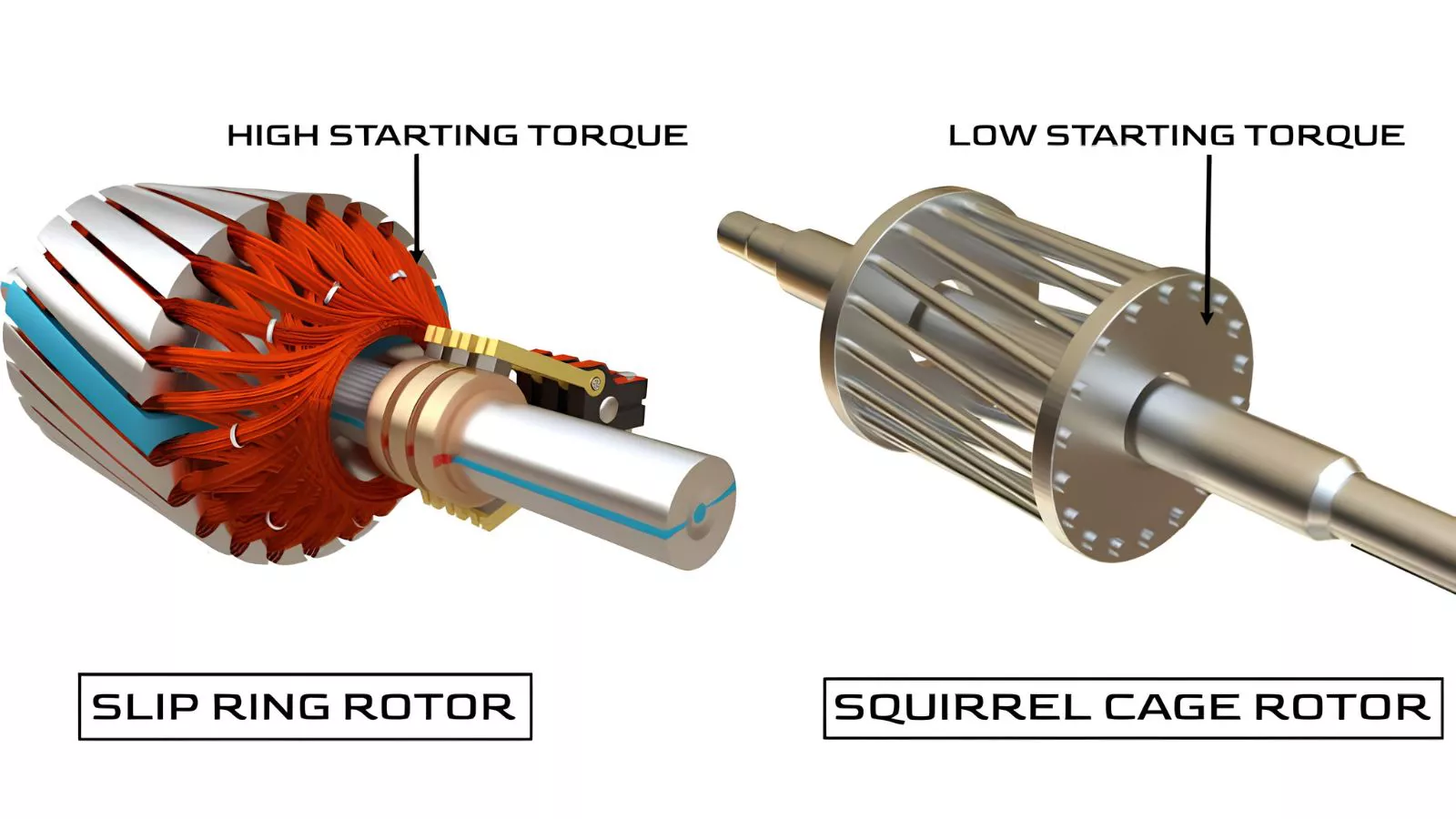
Three phase induction motors are mainly classified by their rotor construction. There are two primary types: squirrel cage induction motors and slip ring induction motors, also known as wound rotor induction motors.
Both types operate through electromagnetic induction. However, their rotor designs affect starting torque, speed control, maintenance, and overall performance.
A slip ring induction motor, also called a wound rotor motor, has a rotor with three-phase windings instead of solid conductive bars. These windings are connected to external circuits through slip rings and brushes.
This design allows external resistance to be added to the rotor circuit during startup. It helps increase starting torque while limiting starting current, which is particularly useful for heavy loads.
Imagine a large industrial crane lifting a heavy steel component. The motor needs strong starting torque to move the load smoothly from a standstill. A slip ring induction motor can provide this extra starting capability through external rotor resistance.
Common applications include:
However, brushes and slip rings require regular inspection and maintenance. This makes wound rotor motors more maintenance-intensive than squirrel cage designs.
A squirrel cage induction motor uses a rotor made of conductive bars, usually aluminum or copper, connected by short-circuiting end rings. This structure resembles a squirrel cage, which is where the motor gets its name.
Its simple rotor design has no brushes or slip rings. As a result, it requires relatively little maintenance and offers reliable operation in demanding environments.
For example, consider an industrial ventilation system that runs for several hours every day. A squirrel cage motor can drive the fan continuously with minimal maintenance, making it a practical choice for this application.
Common applications include:
A three phase induction motor works based on electromagnetic induction. When three-phase AC power is supplied to the stator windings, it creates a rotating magnetic field. This field induces current in the rotor, producing torque and causing it to rotate.
The entire process happens continuously while the motor is running. It can be understood through four basic steps.
When a three-phase AC supply enters the stator windings, the three currents have the same frequency but are separated by 120 electrical degrees.
This phase difference allows the stator to generate a continuously rotating magnetic field rather than a stationary one.
The magnetic fields produced by the three stator phases combine to form a rotating magnetic field inside the motor.
This field rotates at a speed called synchronous speed. Its value depends on the supply frequency and the number of stator poles.
The synchronous speed can be calculated using the following formula:
Ns = 120 × f / P
Where:
For example, a four-pole motor operating on a 50 Hz supply has a synchronous speed of 1,500 RPM.
As the rotating magnetic field passes through the rotor conductors, it induces an electromotive force (EMF). This produces current in the rotor.
The rotor current creates its own magnetic field. The interaction between the stator and rotor magnetic fields generates electromagnetic torque.
The generated torque causes the rotor and motor shaft to rotate. The shaft then transfers mechanical power to connected equipment, such as a pump, fan, or conveyor.
However, the rotor cannot reach synchronous speed during normal motoring operation. If both speeds were equal, there would be no relative motion between the rotating magnetic field and rotor conductors, so no rotor EMF or induction torque would be produced.
The difference between synchronous speed and rotor speed is called slip.
The slip formula is:
s = (Ns − Nr) / Ns × 100%
Where:
Practical example:
Suppose a four-pole motor operates at 50 Hz. Its synchronous speed is 1,500 RPM. If the rotor runs at 1,440 RPM, its slip is:
s = (1,500 − 1,440) / 1,500 × 100% = 4%
This small speed difference allows electromagnetic induction to continue and keeps the motor producing torque.
Although both motors use electromagnetic induction, their rotor construction creates important differences in performance and maintenance.
A squirrel cage motor is generally preferred for simple, continuous-duty applications. A slip ring motor is more suitable when high starting torque and external rotor resistance are required.
The following table highlights their main differences.
| Comparison | Squirrel Cage Motor | Slip Ring Motor |
|---|---|---|
| Rotor Construction | Conductive bars connected by end rings | Three-phase rotor windings |
| Slip Rings | Not required | Required |
| Brushes | Not required | Required in conventional designs |
| Starting Torque | Generally moderate, depending on rotor design | High starting torque can be achieved |
| Starting Current | Can be relatively high with direct-on-line starting | Can be reduced using external rotor resistance |
| Speed Control | Typically uses a variable frequency drive (VFD) for adjustable speed | Can use external rotor resistance or a VFD |
| Maintenance | Low | Higher due to brushes and slip rings |
| Construction | Simple and robust | More complex |
| Cost | Generally lower | Generally higher |
| Typical Applications | Pumps, fans, compressors, and conveyors | Cranes, hoists, crushers, and heavy-duty machinery |
These differences become more important when selecting a motor for a specific industrial load.
Which motor should you choose?
For a standard water pump or ventilation fan, a squirrel cage motor is often the more economical option. Its simple construction and low maintenance make it suitable for continuous operation.
For a crane that must lift heavy loads from a standstill, a slip ring motor may be more suitable because it can deliver high starting torque with controlled starting current.
However, the best choice also depends on the load characteristics, operating cycle, available starting equipment, and total operating cost. A variable frequency drive (VFD) can also provide an alternative solution for applications requiring controlled starting and adjustable speed.
Three phase induction motors are widely used in industrial and commercial environments. Their reliable operation, durable construction, and ability to handle continuous loads make them suitable for many types of machinery.
From moving water through pipelines to transporting materials across factory floors, these motors play an important role in keeping industrial operations running.
Three phase induction motors are commonly used to drive centrifugal pumps, water supply pumps, and wastewater treatment equipment.
They provide consistent rotational power to move water through pipelines, maintain pressure, and support large-scale fluid handling systems.
For example, a municipal water treatment plant may use multiple induction motors to operate pumps throughout the day. Their reliable performance helps maintain a steady water supply.
Industrial fans and blowers rely on induction motors to circulate air, remove heat, and maintain ventilation.
In large commercial buildings, three phase motors also drive HVAC equipment, including air handling units and ventilation fans.
When paired with a variable frequency drive (VFD), motor speed can be adjusted to match changing airflow requirements and reduce energy consumption.
Air compressors use three phase induction motors to generate compressed air for pneumatic tools, production lines, and industrial processes.
Conveyor systems use them to move products and raw materials between different production stages.
For instance, a packaging factory may use several motors to keep conveyor belts moving at a consistent speed while products pass through filling, labeling, and packaging stations.
Heavy-duty equipment often requires high starting torque to move large loads from a standstill.
Slip ring induction motors have traditionally been used in cranes, hoists, mining equipment, and crushers because external rotor resistance can improve starting performance.
Modern installations may also use squirrel cage motors with suitable VFDs to achieve controlled starting and speed adjustment.
Three phase induction motors power a wide range of manufacturing equipment, including machine tools, mixers, grinders, and industrial processing machines.
Their robust construction makes them suitable for factory environments where equipment may operate for extended periods under varying loads.
These applications demonstrate why three phase induction motors remain a common choice across industrial sectors.
Three phase induction motors are popular because they offer a practical balance of performance, reliability, and operating cost. However, they also have limitations that should be considered before installation.
Why does reliability matter?
Consider a factory production line that operates across multiple shifts. An unexpected motor failure can stop conveyors, delay production, and increase operating costs. A properly selected and maintained induction motor helps reduce the risk of unplanned downtime.
These limitations do not make induction motors unsuitable for industrial use. Instead, they highlight the importance of selecting the correct motor design and starting method for each application.
Choosing the right three phase induction motor involves more than matching its power rating to the equipment. You also need to consider the load, starting conditions, operating environment, and expected running hours.
The following factors can help you make a more suitable selection.
Start by determining the mechanical power required by the driven equipment. Motor power is commonly expressed in kilowatts (kW) or horsepower (HP).
A motor that is undersized may overheat or struggle to handle the load. An oversized motor may increase initial costs and operate inefficiently under light loads.
Check that the motor's rated voltage and frequency match the available power supply.
Common industrial supply frequencies include 50 Hz and 60 Hz. Operating a motor at an unsuitable voltage or frequency can affect its speed, torque, temperature, and overall performance.
Also check the motor nameplate for its rated current and connection configuration, such as star (Y) or delta (Δ).
The number of poles and supply frequency determine the motor's synchronous speed. Actual rotor speed is slightly lower because of slip.
For example, at 50 Hz, a four-pole induction motor has a synchronous speed of 1,500 RPM. Its rated operating speed will normally be somewhat lower.
Choose a motor speed that matches the requirements of the driven equipment. If frequent speed adjustments are necessary, consider using a VFD.
Consider how much torque the motor needs to start the connected load.
Fans and centrifugal pumps often have different starting characteristics from heavily loaded conveyors, crushers, and lifting equipment.
If the application requires high starting torque, evaluate suitable high-starting-torque squirrel cage designs, VFD-controlled motors, or slip ring motors.
Also check the allowable starting current to avoid excessive electrical stress on the power supply.
Motor efficiency directly affects long-term operating costs, especially in equipment that runs for many hours each day.
Compare the motor's rated efficiency and applicable efficiency class, such as IE2, IE3, or IE4, according to the relevant IEC standards and local regulations.
A higher-efficiency motor may have a higher purchase price but can reduce electricity costs over its operating life.
Consider where the motor will be installed. Dust, moisture, high temperatures, and corrosive substances can affect motor performance and service life.
Check the enclosure protection rating (IP rating) to ensure the motor is suitable for its environment.
For example, a motor installed in a dusty manufacturing facility may require a different enclosure from one operating in a clean indoor workshop.
Finally, consider installation space, mounting arrangement, cooling method, and maintenance access.
Squirrel cage motors are often preferred when low maintenance is a priority. Slip ring motors may be appropriate when their starting characteristics justify the additional maintenance requirements.
Practical selection tip:
Before purchasing a three phase induction motor, compare its rated power, voltage, frequency, speed, starting torque, efficiency, and protection rating with the actual equipment requirements.
Checking these specifications in advance can help prevent compatibility problems, unnecessary energy costs, and premature motor failure.
The two main types are squirrel cage induction motors and slip ring induction motors. Squirrel cage motors use conductive rotor bars, while slip ring motors use wound rotors connected to external resistance circuits.
Squirrel cage induction motors are the most commonly used type in general industrial applications. Their simple construction, reliable operation, and low maintenance requirements make them suitable for pumps, fans, compressors, and conveyor systems.
A slip ring induction motor can provide higher starting torque by adding external resistance to its rotor circuit. This makes it suitable for heavy-load applications such as cranes, hoists, and crushers.
Yes. A three phase induction motor can operate at variable speeds using a variable frequency drive (VFD). The VFD adjusts the supply frequency to control motor speed and can also provide controlled acceleration and deceleration.
An induction motor produces rotor current through electromagnetic induction and normally operates below synchronous speed. A synchronous motor runs at synchronous speed under steady-state operation, with its rotor field synchronized with the rotating stator magnetic field.
Use the formula Ns = 120 × f / P, where Ns is synchronous speed in RPM, f is supply frequency in Hz, and P is the number of poles. For example, a four-pole motor operating at 50 Hz has a synchronous speed of 1,500 RPM.
Three phase induction motors play an essential role in modern industrial operations. The two main types, squirrel cage and slip ring induction motors, offer different advantages in terms of starting torque, maintenance, and operating performance. Understanding these differences helps you select a motor that matches your equipment, load requirements, and working environment.
If you are looking for a reliable motor manufacturer in China, HONGMA is worth considering. With over 35 years of motor manufacturing experience, HONGMA offers a range of three phase electric motors with IE1 to IE5 efficiency options, as well as different power ratings and housing configurations. OEM and ODM customization is also available to meet specific industrial requirements.
Whether you need a motor for pumps, compressors, conveyors, or other industrial machinery, the HONGMA team can help you find a suitable solution. Contact HONGMA today to discuss your technical requirements and request a customized quotation.

3 Phases Electric Motors In Lifetime Of Conveyor Systems Three-phase electric motors have a great deal to do with how well conveyor systems perform. They help the machines to run smoothly and efficiently. Our company, HONGMA, understands the necessit...

If you need special electric motors for your company. We have it at HONGMA! Our three-phase electric motors are awesome and help your company achieve success. “If you’re an engineer for a machine that has a motor,” asks Rainer Hessmer, “you’d be look...

Asynchronous electric motors are revolutionizing the way business is done. They help machines operate smoothly and avoid wasting energy. HONGMA is one company that is at the forefront of this transformation. Here’s how these motors are employed in fa...